Our 10 storage tips for your children's bedroom

- Categories : Tips

Nateo Concept

10 tips for organizing your children's bedroom

Is your children's bedroom cluttered? Between toys, clothes, and school supplies, it's not easy to keep a room clean and tidy! To help everyone find their way without wasting time, we're sharing our 10 best storage tips. Furnishing, decluttering, storing, organizing - discover how to keep your children's and teens' bedrooms spotless!

1 - Storage furniture

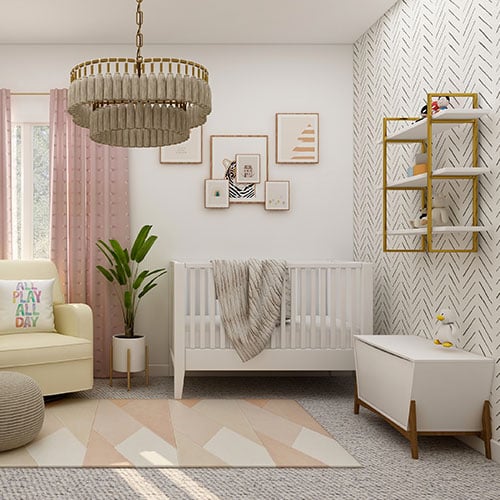
Storage furniture is the first solution to implement for organizing your children's bedroom. If you have enough space in the room, multiply the children's storage furniture: wardrobe, chest of drawers, shelving, and even toy chest. Children's furniture takes up little space and allows for maximum storage.

The key to good organization is the arrangement of these spaces. For this, add storage baskets or boxes and separate the spaces. Store items you use occasionally in the top of the wardrobe and keep everyday items within reach. Logic is your best ally for an organized room!

2 - Smart furniture

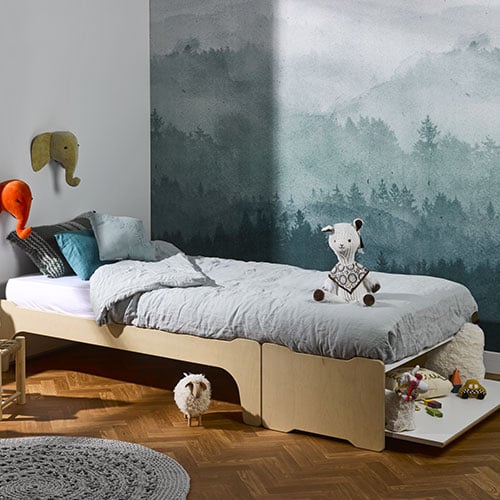
For small spaces or shared rooms, there are practical and functional solutions: modular furniture! 2-in-1 beds offer multiple storage spaces. By opting for a storage bed, you'll have all the free space under the bed frame to store your children's belongings. This furniture is ideal for storing bulky toys, bedding, or winter clothes.

The loft bed or the under-bed drawer are also very practical! Thanks to the loft bed, your child can enjoy floor space for playing, reading, or working. High beds are suitable for all children from around 6 years old. To install a loft bed, we recommend waiting until your child can climb up and down independently.

3 - Floor-to-ceiling storage

The available space in your teenager's or child's bedroom is often poorly used. To optimize storage without cluttering the room, think about using all the space. Thus, walls, corners, and high ceiling heights will no longer be obstacles, but assets in bedroom organization!

To make the most of storage possibilities, you can:

  • Install a corner shelf. They take up little space and allow you to store your children's books, games, or toys. Corners are too often wasted spaces that you can actually use.
  • Hang wall shelves. These small occasional furniture pieces are incredibly effective for storing everyday small items. Take the opportunity to bring in light with a table lamp. A bright room will then appear larger!
  • Consider hanging storage. The idea and implementation are simple: suspended baskets, boxes, or bins allow you to save space. Say goodbye to toys scattered on the floor!
  • Use the space above furniture. If you have a wardrobe or chest of drawers in your children's room, don't forget to use the free space between the top of the furniture and the ceiling to store bulky or rarely used items.

4 - Baskets: simplified organization

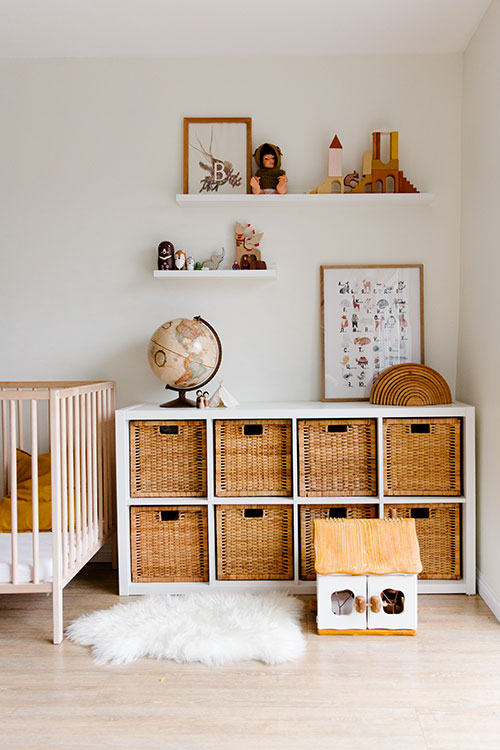
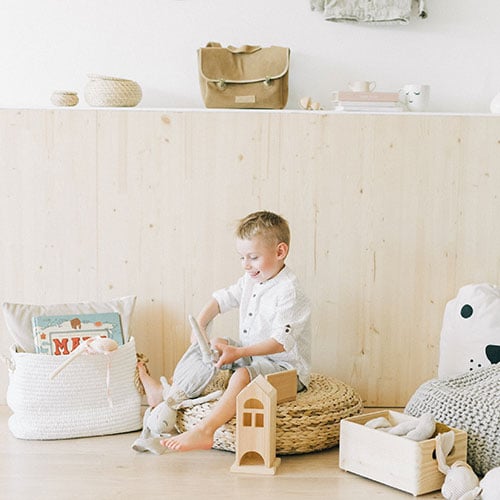
Whatever the size and layout of the room, storage baskets will make your daily life easier! Made of wicker or wood, colourful or neutral, they also become real decorative elements.

Storage baskets are also practical for teaching your children to tidy their room by themselves. Indeed, they are easily accessible and manageable, which allows children, even young ones, to store games and toys independently!

5 - Sorting out

This solution may seem simple, but it's very effective. Children grow up quickly and their tastes constantly evolve. Games and toys quickly become obsolete. Instead of keeping all the stuffed animals, board games, and construction toys, sort through them with your children. They won't hesitate to tell you which toys they no longer like or want.

By regularly sorting through the wardrobe and your children's room, you'll quickly gain space. They can use this space for new activities or new games.

6 - Swapping and donating to change without cluttering

Do you like change? Don't panic, solutions exist! If your teenager or child likes to regularly change clothes or toys, opt for donation and exchange. Many online selling platforms between individuals or exchange platforms allow you to find swaps near you.

This solution is both practical and ecological. Thanks to donation or swapping, your children can enjoy new items when they want while others benefit from your old belongings.

Selling and exchanging between individuals is very interesting, especially for clothing. Little ones grow quickly and often only wear their clothes once or twice before they become too small. You can therefore make good deals by getting quality clothing at a lower cost.

7 - Storage bench: the ally of attic rooms

This tip applies to all layouts, but it's particularly interesting for attic rooms. If you've set up your children under the roof, opt for storage benches. Placed in the lowest part of the room, these occasional furniture pieces allow for storage and create a reading corner for the youngest.

8 - The door, a neglected space

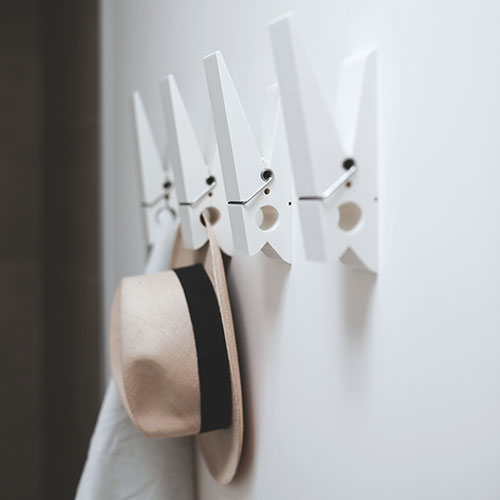
Have you ever thought about using the bedroom door as storage space? For very small rooms, every square metre must be used, so why neglect this vertical space?! A clothes rack or hooks are ideal for hanging clothes on the back of the door. You can also buy or make a vertical storage unit that will hang in the doorway. A few baskets or storage pouches will then hold your children's small items.

9 - Mobile storage solutions

The modular storage solutions are a clever organization technique. Depending on your needs and your children's activities, you simply need to move a toy chest on wheels or a wooden box to create a new space. A wooden block can become a seat, a table, or simply a storage box as needed.

10 - The "Switch" technique

The last tip to declutter your children's room is to adopt the "Switch" method. Whether boy or girl, young children often have more toys than necessary! By giving them a wide choice of activities, they can feel lost with all the possibilities and will be tempted to take everything out at once. To prevent them from turning their room into a giant playroom, alternate the toys at their disposal.

Sort their belongings and offer them only 2 or 3 games or toys maximum. Store the rest in boxes that you'll keep out of their reach. Then, all you have to do is "switch" or alternate the toy boxes every month or every two months. Your children will be delighted to discover new activities and rediscover toys they had forgotten!